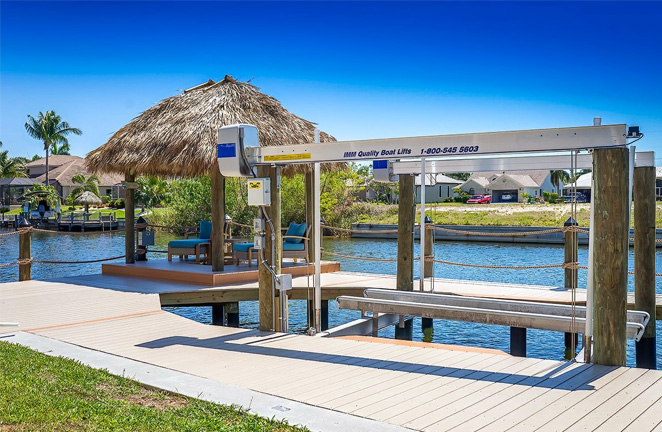
As a boat owner, you rely on your boat lift to smoothly lower and raise your vessel. But when the boat lift won’t go up, it can cause frustration and delays. Fortunately, many common boat lift problems are easy to fix if you know what to look for. In this guide, we’ll walk you through the most frequent causes and solutions for a boat lift that isn’t lifting, from electrical issues to mechanical problems.
1. Check the Power Source
The first thing to check when your boat lift won’t go up is the power source. Boat lifts rely on a steady electrical connection, so any interruption in power can prevent your lift from operating.
- Circuit breaker: Verify that the circuit breaker hasn’t tripped. If it has, reset it and see if the lift starts working again.
- Remote control: If you were using the remote control, see if the lift operates properly using the control box. If it does, you need to simply replace the batteries in your remote.
2. Check Your Bilge
It is possible that your bilge pump has stopped working and your bilge is full of water. All the extra weight from a full bilge can overload a boat lift and prevent it from lifting. Simply drain your bilge.
3. Inspect the Lift Motor
If your power source is working fine, the next step is to inspect the motor. A boat lift motor is responsible for lifting and lowering your boat, and if it malfunctions, the lift won’t operate.
- Motor hums but doesn’t operate: If your boat lift motor is making noise but isn’t lifting, the issue could be related to the motor’s start capacitor or start windings. You may need to contact a boat lift dealer for assistance or replace the part yourself if you’re comfortable with basic repairs.
- Most boat lifts have two top beams. If only one is working, check the wiring to the side that is not running. Use a multimeter to confirm the motor is receiving adequate voltage
- Exposed motor full of water: Was the motor submerged due to storm surge? Alternatively, the seals and gaskets on a motor can fail over time and the motor may take on water from rainstorms. Replace the damaged motors.
- Wiring connections: Damaged wiring,loose connections or corroded terminals can lead to electrical issues that prevent your boat lift from raising. Inspect the wires leading to your lift motor for any wear and tear. If you see frayed wires or corrosion on the connections, replace the damaged wiring and connections.
4. Check the Lift’s Hydraulic System (If Applicable)
If your boat lift uses a hydraulic system, low oil levels or trapped air in the system may be causing the lift not to operate correctly.
- Oil level: Check the oil level in the hydraulic tank. If it’s too low, add the appropriate hydraulic fluid for your lift model.
- Trapped air: Trapped air in the hydraulic lines can prevent the lift from operating. Bleeding the system to release the air is a common solution.
- Lift cylinder or lift tube: Inspect the hydraulic lift cylinder and lift tube for leaks or signs of wear. If you notice oil seeping past seals, it may be time to repair or replace these components.

5. Test the Control Box
Your lift’s control box houses the electronics that power the lift. If the boat lift won’t go up, the control box could be malfunctioning.
- Attempt a manual override: GEM control boxes have manual overrides labeled “Emergency Override Up” and “Emergency Override Down”. Use a rod (like a pencil) to depress the “Emergency Override Up” contactor (inside the hole). If the boat lift goes up, you have damaged wiring or corroded terminals within the control box.
- Manual control boxes (like the Bonita) do not have overrides. The only way to determine if the toggle or drum switches are malfunctioning is to test for continuity between the poles (terminals). If you don’t understand what this means, consult an electrician.

6. Inspect the Limit Switch
A limit switch controls how far your boat lift can travel up or down. If the limit switch is out of alignment or malfunctioning, the lift may not rise at all.
- Check the switch: Ensure that the switch isn’t stuck in a position that prevents the lift from rising. Adjusting the switch may resolve the problem.
- Damaged wiring: Sometimes, the wiring connected to the limit switch can become damaged. Inspect these wires for wear and replace any that are frayed or broken.
7. Investigate Mechanical Issues
Mechanical problems can also prevent your boat lift from going up. Regular maintenance can help prevent many of these issues, but over time, parts can wear out or get damaged.
- Pulleys: If pulleys are seized or obstructed by debris, they won’t spin freely, making it difficult for the lift to operate. Applying penetrating oil to the pulleys and checking for rust or debris can resolve this problem.
- Gears and sprockets: Boat lifts with flat-plate drives and chain drives have sprockets that require lubrication. Make sure that the sprockets are not rusted and that they are lubricated with marine grade roller chain lube. The sealed direct drive gearboxes can also become rusted and damaged over time. The most common problem is that a tooth will break off of the gearing while running, causing the gearbox to lock-up. Contact a marine contractor to replace these gearboxes.
- Hoist and platform: Inspect the top beams, cradle beams and bunks for any misalignment or obstruction. Sometimes, debris can get caught in the system, preventing the lift from moving freely. Sometimes, when there is minimal space within a slip, the cradle beams or bunks may hit the underside of the dock, preventing the lift from moving. Make sure that the lift, bunk system and boat are all properly aligned within the dock and slip.
- Normal wear: Over time, the constant lifting and lowering of your boat puts strain on the mechanical components. Check for any signs of damage that may need immediate attention.
8. When to Contact a Professional
If you’ve gone through these troubleshooting steps and your boat lift still won’t go up, it’s time to contact a boat lift dealer or professional technician. Some issues require specialized equipment or knowledge to resolve, and continuing to operate the lift in its current state could lead to more serious damage.
Conclusion
A boat lift that won’t go up can be caused by a variety of factors, from electrical issues like a tripped circuit breaker or damaged wiring to mechanical problems such as frayed boat lift cables or a worn motor. By following these troubleshooting steps, you can identify common boat lift problems and know when it’s time to call a professional for repairs. Regular maintenance and careful attention to the condition of your boat lift will help keep it operating smoothly for years to come.